


Tutima Glashütte and the "Patria" watch line – craftsmanship meets modernity
Tutima glassworks on the Inhorgenta 2026Hall A1, Booth 312
Upon entering the Tutima building in Glashütte, one doesn't immediately get the impression that it's solely about the mundane production of watches. The ambiance exudes a pure sense of well-being.
This also applies to the workshops where designs, manufacturing, assembly, and finishing take place – even individual components are created here. Far removed from the typically rather coldly furnished watchmaking workshops, at Tutima in Glashütte, around 30 employees work at dark wooden workbenches, allowing the long tradition of watchmaking to be grasped at a glance.

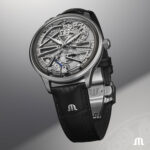
This is where watches like the Patria are made, which Tutima Glashütte is presenting at Inhorgenta in three new titanium versions.
3 new Patria variants in titanium


„Incidentally, "Patria" comes from Latin and means fatherland or homeland. And so, the new models embody Glashütte watchmaking artistry in every detail. This is especially true of the hand-wound Tutima Calibre 617 movement, which is meticulously handcrafted from 171 individual parts in the company's own manufactory.

You can find out more about the home and roots of Tutima Glashütte here.
The finished work can be viewed through a sapphire crystal on the back of the case: The Glashütte three-quarter plate with its striped finish, hand-beveled chamfers and ruby bearings set in screwed gold chatons unmistakably points to its rich heritage.

The power of the gear train is transferred to the balance wheel by the anchor, specially crafted in the Glashütte workshop, thus ensuring the heartbeat of the movement. The balance wheel itself is also meticulously handcrafted: watchmakers bend the Breguet overcoil with its specially calculated terminal curve by hand before it is installed as part of the free-sprung balance system. When fully wound, the power reserve is 65 hours.

Titanium expertise for Patria
Furthermore, the "Patria" line marks the first time the brand's decades of expertise in titanium are put to use. The highly polished case, with a contemporary diameter of 41 millimeters, is crafted entirely from Grade 5 titanium, combining light weight with high scratch and corrosion resistance while remaining comfortable against the skin. A curved crown guard encloses the ergonomically shaped and knurled crown.
Detailed dial
Protected under domed and anti-reflective sapphire crystal, the dial reveals a wealth of detail and a modern look in anthracite, graphite grey or silver-white: depending on the angle of incidence, light and shadow alternate on the pyramid structure.

The circular path of the small seconds subdial traces a fine grooved pattern, while the outer minute track on a flat surface visually frames the dial. Together with the diamond-cut indices, the hand-finished hands with white luminous material blend harmoniously into the design; in the dark, they glow blue.

The dial not only shows hours, minutes and seconds, but also the historical logo from the founding of the brand almost one hundred years ago.
A harmonious triad
Several color combinations are available: The version with an anthracite dial and black calfskin strap features striking contrasts. The "Patria" with a graphite gray dial and sheepskin strap has a technically modern look, while the version with a light brown sheepskin strap and white-silver dial conveys a warm elegance. (RRP €8,600)

Experience Glashütte watchmaking up close at Inhorgenta
At a workbench from the workshop, a Tutima watchmaker at Inhorgenta provides diverse insights into the mechanical skills of the manufacture: from manually bending the terminal curve of a Breguet spiral to the elaborate finishing of ratchet parts with a striped finish and hand-angled beveling, to the complete assembly of an anchor as well as gear train and hands.
Tutima and the beginnings in Glashütte
In 2008, Tutima purchased this premises in the former stationmaster's office in Glashütte, located in the immediate vicinity of the historic manufactory, and opened it in 2011. However, the watch manufacturer and family business did not find a new home with this move, but rather returned to its geographical roots.

Start in the Roaring Twenties
For Tutima's story began back in 1927, a time of upheaval in society, art, culture, and science – also in Glashütte. In this watchmaking town, the Roaring Twenties fostered optimism and the courage to try new things.

And so the Glashütte Watch Movement Factory (UROFA) and the Glashütte Watch Factory (UFAG) were founded. Both were established and managed until their closure in 1945 by Dr. Ernst Kurtz (left), a lawyer who quickly recognized that the future belonged not to the then still widespread pocket watch, but rather to the wristwatch.
His best models quickly proved comparable to those of Swiss brands. Due to their exceptional durability and resilience, they earned the title "Tutima" in the 1930s, derived from the Latin word for "secure." Their quality and distribution – even then exclusively through select specialist retailers – secured the Tutima brand's excellent reputation. At that time, around 1,000 people worked for UROFA-UFAG.
The political situation at the time was less secure. This success story was thus brought to an end by the Second World War and was not continued after its conclusion, or rather, it was continued in a different way.
Escape to the West
One day before the end of the war, Glashütte was bombed by Soviet aircraft, and the production facilities were severely damaged. Kurtz escaped with some employees to the American occupation zone in Franconia and, using equipment from an existing Glashütte branch there, established the Dr. Kurtz watch factory, which he later relocated to Ganderkesee near Bremen.

It wasn't just in terms of expertise that the old days were revived: the movement factory was given the name Nurofa – Norddeutsche Uhren-Rohwerkefabrik (North German Watch Movement Factory), and the dials bore the name Glashütter Tradition.
A fateful encounter
1954 was a pivotal year – not only because Germany became football world champions for the first time. A young man successfully completed a job interview – at Nurofa. He got the job. His name: Dieter Delecate. The fortunes of Tutima watches would remain inextricably linked to him ever since.
„On my very first day he told me about Glashütte and Tutima,“ Delecate recalls of his first encounter with Dr. Ernst Kurtz, which was obviously formative.
In 1957 he founded his own wholesale watch business and in 1960 the Dieter Delecate watch factory in Ganderkesee, which later became Tutima Uhrenfabrik GmbH. In the same year, he acquired the rights to the name Tutima, which he registered as a trademark in 1970.
And this was entirely in keeping with the original founder's wishes. Delecate possesses a private letter in which Kurtz writes: "I consider Dieter Delecate to be my successor."„
Tutima and the international rise
Under Delecate's leadership, Tutima Glashütte became an internationally successful brand. He consistently relied on the strength and foresight of a family business.
Today, his children Jörg and Ute Delecate are active as shareholders. Since the beginning of 2025, they have been supported by the experienced watchmaker Matthias Stotz, who has taken on the role of CEO.

„With German reunification, our father, Dieter Delecate, who had taken over and continued the brand from his mentor Dr. Kurtz, was presented with the historic opportunity to bring Tutima back to its homeland. In 2008, the circle was completed, and we have since been represented again at our birthplace – with our own manufacture, from which four watch lines originate: the exclusive gold manufacture caliber models such as the ‚Patria‘ and ‚Tempostopp‘, as well as the first wristwatch minute repeater made in Germany: the ‚Hommage‘. Then there is the ‚M2‘ series as the successor to the NATO chronograph with the extensions ‚M2 Seven Seas‘ and ‚M2 Coastline‘; the family of distinctive pilot's watches, for which the aforementioned legendary pilot's chronograph served as the model,“ explains Jörg Delecate.


